Eng Ah King, Goon Dip, & the Alaska-Yukon-Pacific Exposition
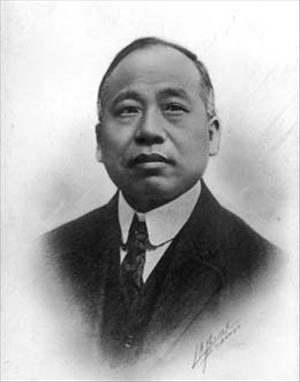
Eng Ah King was born in China in 1863 and immigrated to the United States in 1877 (Dougherty 2013). He eventually made his way to Seattle in 1897, 11 years after the anti-Chinese riots that devastated the Chinese community. At the time of his arrival, the Chinese American population was small and struggling due to ongoing anti-Chinese sentiments. However, King was a determined businessman. Upon his arrival in Seattle he founded a restaurant, and later the Ah King Company (also known as King Chong Lung Company), which sold Chinese groceries and dry goods to other local businesses and work camps. Alongside his restaurants and store, King also became a successful labor contractor, helping Chinese migrant workers find jobs on farms and railroads, and at lumber mills and canneries (Chin, 2009). Despite the prevalence of sinophobia and racism, King was able to gain respect from not only his fellow Chinese businessmen, but his white counterparts as well. Over the years, he became the informal “mayor of Chinatown”.
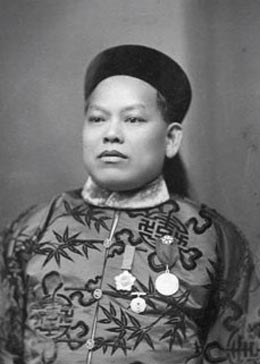
Goon Dip was born in China around 1862. Initially settling in Portland in 1876, he stayed for just a few years before returning to China because of the rise of anti-Chinese sentiment (Chesley, 2009). He managed to make his way back to Portland around 1882 and dove headfirst into learning English from his newfound friend, Ella McBride, and labor contracting and hotel management from his mentor Moy Bok-Hin. While in Portland, he also helped establish a garment industry that employed Chinese men who had become physically disabled and were unable to do the strenuous manual labor that was often required of migrant workers. Goon trained them in sewing so they were able to pay off the rest of their debts owed to contractors.
These business ventures caught the attention of the Chinese government and subsequently, Goon and Moy were appointed honorary consul for the 1905 Lewis and Clark Exposition in Portland. He was later called to Seattle in 1908 ahead of the city’s own exposition, again, as an honorary consul.
As world’s fairs and expositions became more popular in the mid-1800s and into the 20th century, it made sense for Seattle to host its own world’s fair as a rapidly growing city in its own right. This came to fruition in the summer of 1909 when the Alaska-Yukon-Pacific Exposition (AYPE) came to the University of Washington’s Seattle campus. Like many expositions of the time, the AYPE showcased the cultures, goods, and entertainment that various countries had to offer in an effort to promote Seattle as a new gateway to Alaska, the Yukon, and the Pacific (Hackett Nicola, 2010). In the case of the Chinese Village at the AYPE, Ah King and Goon Dip became the lead organizers, seeing this as an opportunity to ease racial tensions and to show the United States government just how valuable it would be to loosen the strict immigration laws and outright exclusion faced by the Chinese community at the time. Since the Chinese government did not sponsor the Chinese Village (Chesley, 2009), King and Goon donated funds themselves, and it is said that almost all of the Chinese people in the city each contributed $4 to the cause (Chin 2009, 45). Prior to the fair in December 1908, King had gone back to China to scout concession workers, actors, and acrobats. He was able to pay their passage and salaries, and used his business savvy to negotiate a reasonable financial agreement with the exposition officials. Goon also diligently sought after and sourced artifacts to be displayed in exhibits from his contacts in Seattle, Portland, and San Francisco (Hackett Nicola, 2010). The village consisted of three main buildings that contained a bazaar, a Chinese temple, Ah King’s restaurant and tea room, and more (Dougherty, 2009). In the restaurant, visitors were encouraged to order Chinese dishes and eat with chopsticks for a more authentic experience. The Chinese theater was undoubtedly a favorite in the village, with juggling, magician, and acrobatic performances captivating the crowd (Hackett Nicola, 2010). In the end, although the Chinese Village didn’t turn a profit, it was still a hit amongst fair goers and exemplified the Chinese community’s dedication to showing the beauty of their culture to those unfamiliar with it and hopefully changed some minds along the way.
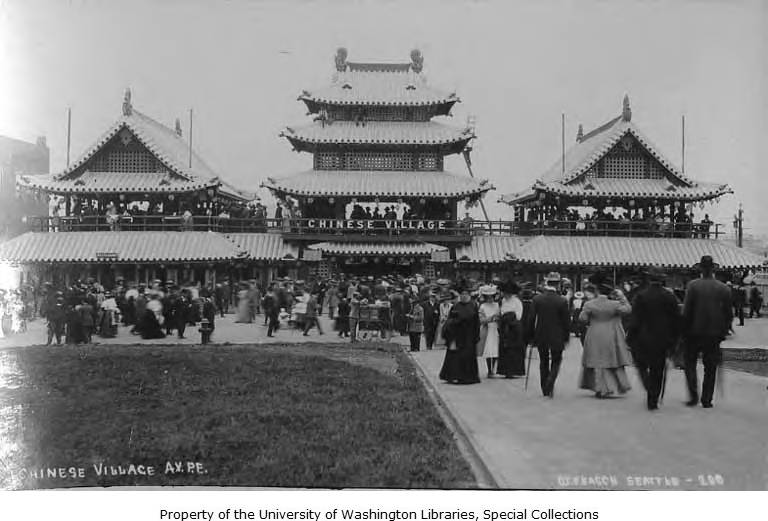
University of Washington Libraries, Special Collections, AYP1472
In the years following the AYPE, Ah King ran into trouble due to gambling raids carried out in the Chinatown neighborhood and died in 1915 (Dougherty, 2013). Goon Dip continued his business ventures in the neighborhood as well. He built the Milwaukee Hotel in 1911, which he occupied with his family until his death in 1933 (Chesley, 2009). The building is still standing today and continues to provide the community with housing, restaurants, and storefronts.
About the writer: Maria Vipond hails from Tacoma, WA and is a current resident of Seattle. She graduated from the University of Washington with a B.A. in International Studies (Asia focus) in 2022. Since then, she has been working at the Wing Luke Museum and hopes to continue on a career path serving the community by telling stories from Seattle’s rich history that are often overlooked.
Donate
Acknowledgements